Coding's End Game: Why Elon's AI-Generated Binaries Beat Compilers
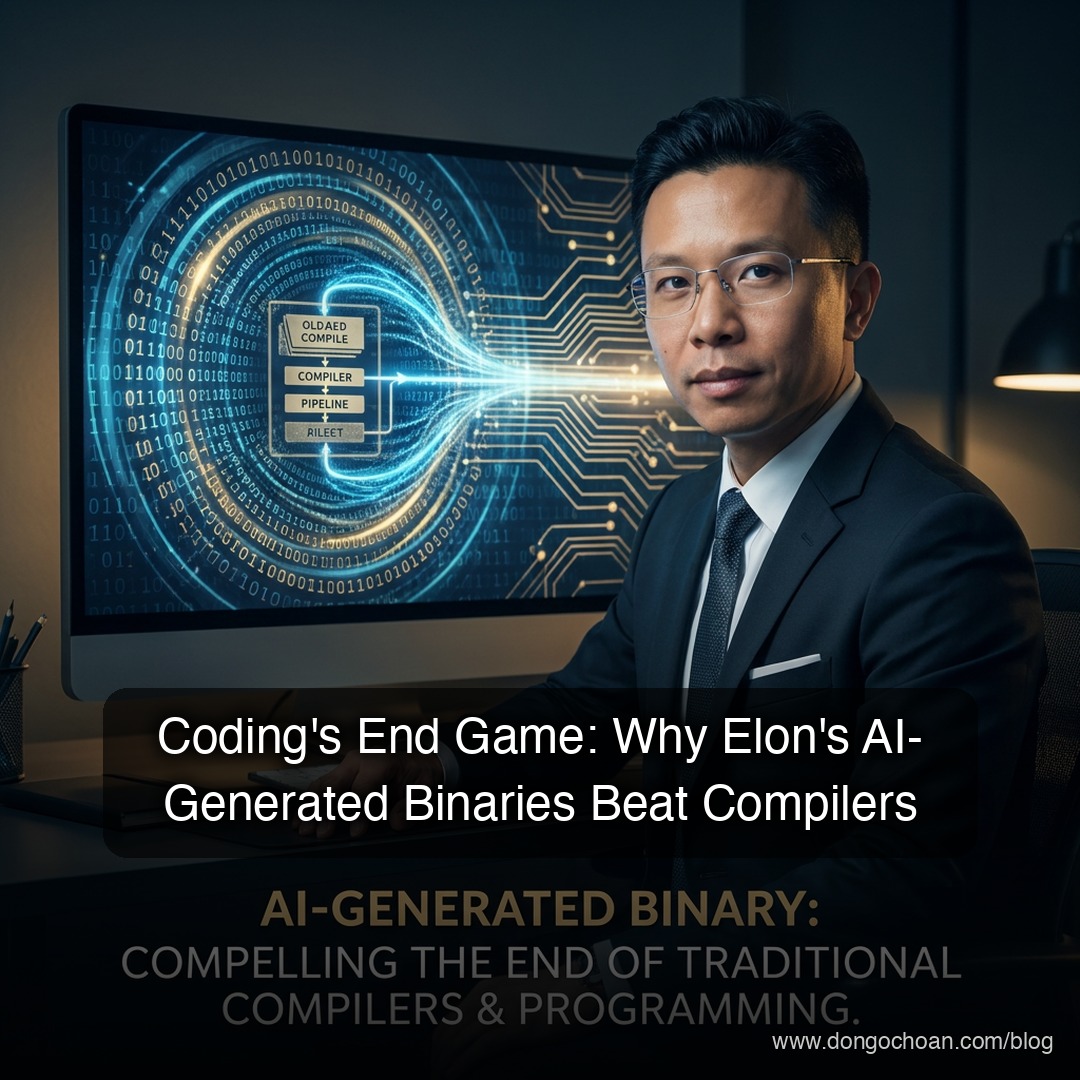
The AI Binary Revolution: Why Elon Musk Thinks Compilers Are History
Elon Musk recently made a bold claim: AI won't just assist programmers—it will make coding itself obsolete by the end of the year. His argument hinges on a technical insight often overlooked: AI-generated binaries can be more efficient than anything hand-optimized compilers produce. But is this prediction visionary or hype? Let's break it down.
Understanding Musk's Claim
In a recent statement, Musk suggested that coding is merely "an intermediate step that actually will not be needed." The reasoning is straightforward:
- •Traditional workflow: Humans write code → Compilers optimize → CPU executes
- •Musk's vision: AI reasons directly about computational goals → AI generates optimal binaries → CPU executes
The critical insight? Compilers operate within human-imposed constraints. They can't violate language semantics or rewrite logic arbitrarily. An AI unrestricted by such rules could theoretically generate tighter, faster machine code.
The Technical Reality Check
- •
Compilers Are Already AI-Optimized (Sort Of) Most modern compilers use machine learning for branch prediction, code layout optimization, and vectorization. They're closer to what Musk describes than we might think.
- •
Binary Efficiency Requires Domain Knowledge Generating optimal binaries isn't just about speed—it demands understanding the target architecture (CPU cache lines, branch prediction, vector instruction sets). Current AI models struggle with this level of specificity.

Hoan Do
Founder at Wizy Marketing Agency. Passionate about helping Vietnamese businesses in North America scale with modern technology and premium marketing strategies.
Learn more about us →