The "Thinking" Shift: Why ChatGPT 5.2 & Gemini 3 Just Killed the "Chatbot"
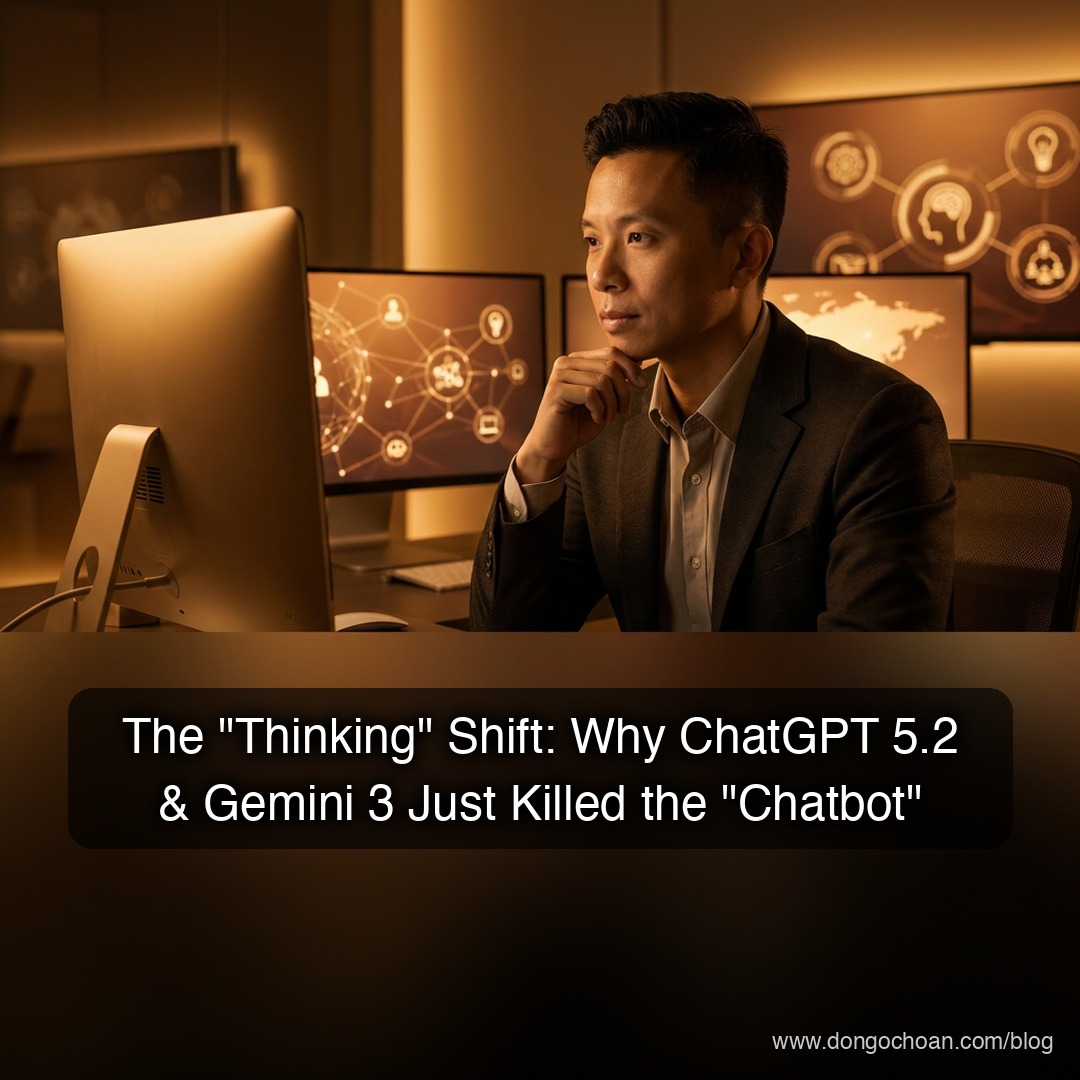
The Technical Angle: Inference-Time compute
Until recently, LLMs were essentially sophisticated pattern matchers—System 1 thinkers (fast, instinctive, prone to error). If you asked a model a complex architectural question, it predicted the next word based on probability.
The new "Thinking" tier in ChatGPT 5.2 and Gemini 3 fundamentally alters this architecture. These models utilize inference-time compute. When you submit a prompt, the model doesn't just generate; it spins up a hidden "chain of thought" process, exploring multiple reasoning paths, self-correcting logical fallacies, and verifying code syntax before streaming a single token back to the user.
We are seeing a trade-off that was previously unacceptable: massive latency for massive accuracy.
The Business Impact: The "Agentic" Unlock
Why does this matter for your P&L? Because "System 1" models were terrible employees. They were fast but required constant supervision (human-in-the-loop).
The "Thinking" class of models finally makes Autonomous Agents viable for enterprise workflows. Amazon’s recent push to call these agents "Teammates" is marketing fluff, but technically, it’s accurate.
- •Cost Efficiency: You are no longer paying for drafts; you are paying for outcomes. A model that takes 45 seconds to "think" costs more in compute, but if it eliminates the 2 hours a developer spends debugging a hallucination, the ROI is exponential.
- •Workflow Reliability: In Wizy's internal tests, using "Thinking" models for autonomous code migration reduced failure rates by nearly 60% compared to GPT-4o class models.
#AIAgents #Strategy #FutureOfWork

Hoan Do
Founder at Wizy Marketing Agency. Passionate about helping Vietnamese businesses in North America scale with modern technology and premium marketing strategies.
Learn more about us →